.png)
Case Study: How a Professional Services Firm Reduced Finance Costs by 45% and Accelerated Month-End Close Using Offshore Accounting Staff

Rupali Singh

January 5, 2026


Harbourview Advisory is an Australian professional services firm delivering consulting and managed services to SME and mid-market clients across multiple states. Operating through several legal entities, the business depends on accurate financial reporting, precise payroll execution, and disciplined cash-flow management to maintain margins, meet compliance obligations, and support ongoing growth.
As the firm expanded its client base and service offerings, financial complexity increased. Transaction volumes rose, reporting cycles tightened, and leadership required more timely and granular financial insight to support decision-making.
By 2024, Harbourview’s finance function was struggling to keep pace with the business.
Rising Australian salary costs made it increasingly difficult to add finance capacity locally without impacting profitability. At the same time, delayed reconciliations, growing compliance workloads, and execution bottlenecks were placing sustained pressure on the team.
Month-end close processes were slowing, payroll accuracy was becoming harder to maintain during peak periods, and senior accountants were being pulled into day-to-day execution rather than analysis, forecasting, and commercial support.
What began as an operational strain was becoming a structural limitation on growth.
After partnering with Remote Office, Harbourview restructured its finance operating model by embedding offshore accounting roles into its existing team.
Within months, the firm:
Most importantly, senior finance leaders were able to refocus on higher-value activities that directly supported business growth and profitability.
Harbourview’s finance challenges were not caused by lack of capability, but by capacity and structure misalignment as the business scaled.
Several compounding issues emerged:
Senior accountants were spending a disproportionate amount of time on:
This reduced their availability for financial analysis, forecasting, and leadership support.
As workloads spiked around payroll and month-end, reconciliations and pay runs became more error-prone. These issues increased rework, delayed reporting, and raised compliance concerns.
Month-end close regularly extended beyond internal deadlines, limiting leadership’s ability to access timely performance data and make informed decisions.
Hiring experienced mid-level accounting talent locally proved:
This made it difficult to scale the finance function in line with business growth.
Collectively, these issues meant the finance team was increasingly reactive rather than strategic. Leadership lacked timely insights, forecasting became harder to maintain, and finance risked becoming a blocker rather than an enabler of growth. Without intervention, the firm faced rising operational risk, staff burnout, and declining financial agility.
This context set the stage for a change in operating model—one that would add capacity, restore control, and allow finance to support the business at a strategic level.
Rather than replacing Harbourview’s existing finance structure, Remote Office worked closely with leadership to extend the firm’s finance capability offshore in a way that aligned with current systems, controls, and reporting expectations.
The objective was not to outsource accounting tasks, but to embed dedicated offshore professionals into defined roles that removed execution pressure from the onshore team while preserving accountability and governance.
The initial offshore accounting team was designed to stabilise high-volume, execution-heavy processes that were consuming disproportionate time locally:
Each offshore role had clear scope, defined outputs, and documented responsibilities, ensuring accountability mirrored that of equivalent onshore positions.
All offshore staff worked inside Harbourview’s existing accounting environment, including Xero and integrated payroll systems. No parallel tools or workaround processes were introduced.
To ensure seamless collaboration:
This ensured offshore accountants operated as a genuine extension of the finance team, not as a separate service layer.
The transition to offshore accounting followed a structured, low-disruption implementation model designed to protect reporting continuity and compliance from day one.
The onboarding process included:
This approach ensured there was no sudden handover of critical finance activities and no loss of institutional knowledge.
Strong governance was embedded from the outset:
Statutory sign-off, approvals, and commercial judgment remained firmly onshore.
To maintain transparency and trust, Remote Office implemented:
This governance framework ensured offshore performance was visible, measurable, and continuously improving.
By embedding offshore accounting roles with defined ownership, robust governance, and full system integration, Harbourview was able to:
This solution laid the foundation for the measurable performance and cost improvements realised in the months that followed.
The impact of embedding offshore accounting roles was evident within the first reporting cycles. By stabilising execution-heavy processes and introducing clear ownership, Harbourview achieved consistent, repeatable improvements across core finance metrics.
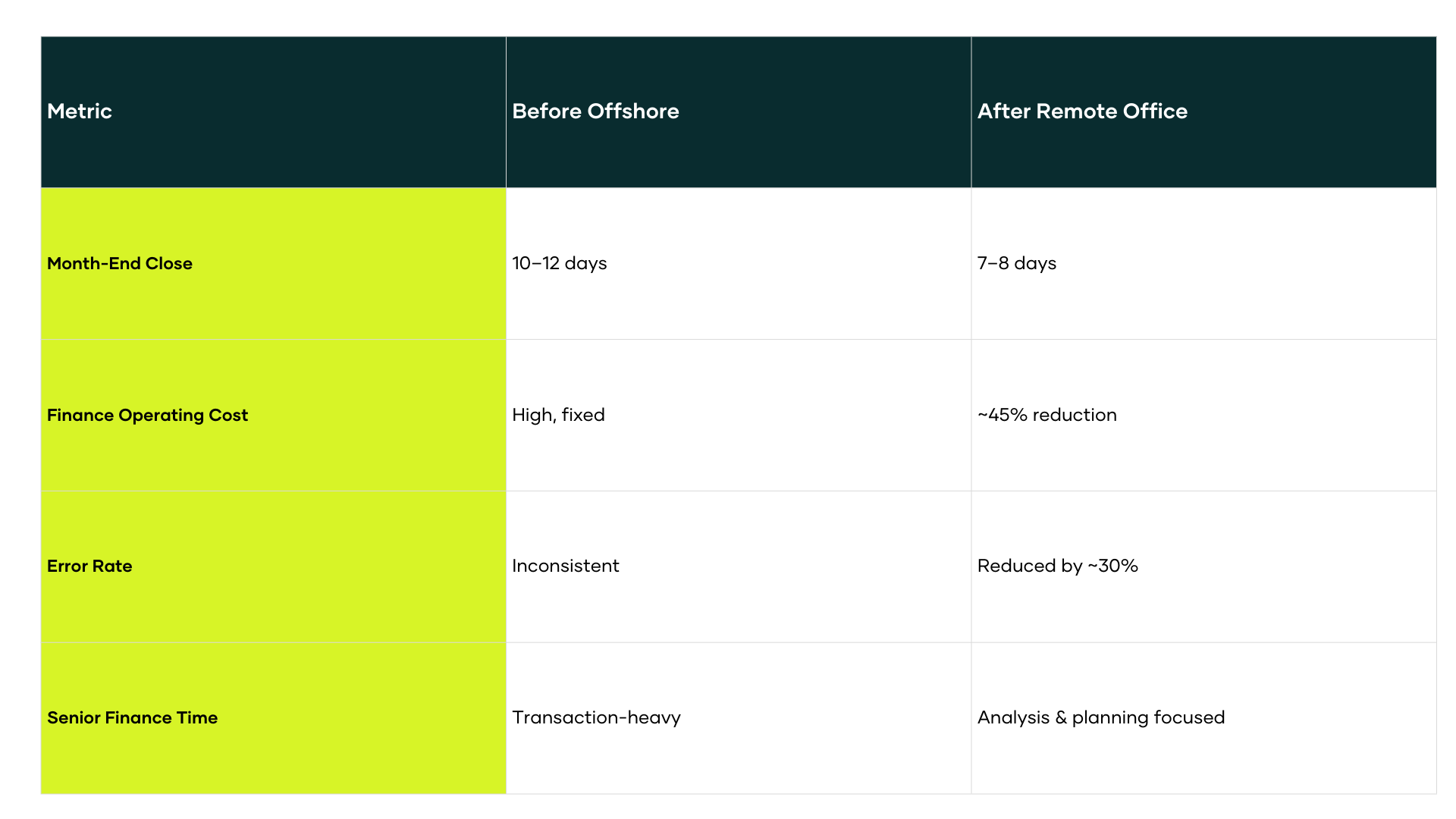
Shorter month-end close cycles were driven by earlier completion of reconciliations, cleaner data inputs, and reduced last-minute corrections. Reporting became more predictable, allowing leadership to rely on financial information with greater confidence.
Cost efficiency was achieved without compromising capability. The offshore model reduced reliance on expensive local mid-level hires while maintaining output quality and compliance standards.
Error reduction reflected the benefits of dedicated role ownership, documented processes, and reduced pressure during peak periods. This lowered rework and compliance risk across payroll and reconciliations.
Senior finance capacity shifted meaningfully. Time previously spent overseeing transactions and resolving issues was redirected towards review, interpretation, and strategic support.
Beyond operational metrics, the offshore accounting model delivered structural improvements to how Harbourview’s finance function supported the business.
With transactional workload stabilised:
The cultural impact was equally important. Reduced operational pressure led to lower stress and higher job satisfaction within the onshore finance team. Senior staff were no longer in constant execution mode, improving retention and engagement at a leadership level.
The flexible offshore engagement model also gave Harbourview the ability to scale finance capacity during peak periods without committing to permanent local headcount, improving financial agility and cost predictability.
By embedding offshore accounting staff through Remote Office, Harbourview successfully repositioned its finance function.
What was once a reactive, execution-heavy cost centre became a scalable, insight-driven operation—capable of supporting growth without sacrificing control, compliance, or accuracy.
The offshore accounting model delivered:
For Harbourview, offshore accounting was not a short-term cost initiative. It was a long-term operating model decision that created flexibility, stability, and confidence in the finance function—ensuring finance enables growth rather than constrains it.
Explore how Remote Office helps you build and scale high-performing offshore teams aligned to your business and delivery needs.

.png)
.png)
.png)
.png)
.png)
.png)
.png)