Remote Office is an end-to-end remoteOps platform that helps you build and manage global remote teams. We provide you with access to top-vetted talents, handle compliance and HR issues, and offer strategic consultation and support to optimise your team’s performance and productivity.
The 80/20 Playbook for Scaling Smarter in Australia with AI + Offshore Teams
Rupali Singh
August 8, 2025
Scaling Smarter in Australia’s High-Cost, High-Pressure Market
Running a business in Australia in 2025 means operating in one of the most competitive and expensive environments in the world. The pressure is coming from every direction — affecting tech startups, established enterprises, and service providers alike.
The Core Challenges
Local talent is scarce and costly
Skilled professionals are in short supply.
Salaries have risen sharply in recent years.
Competition with larger players drives recruitment costs up and extends hiring timelines.
Projects take longer than planned
Limited capacity means even the best teams are stretched.
Deadlines slip, opportunities are missed, and the workload backlog grows.
Margins are shrinking
Wage growth, compliance obligations, and inflation increase operational costs.
Protecting profitability becomes harder with each passing quarter.
Why Traditional Scaling Fails
In this climate, simply adding more local hires isn’t a sustainable or scalable fix. It’s like trying to put out a fire with petrol — costs soar, complexity rises, and pressure on your team intensifies.
What’s needed is a smarter, more agile way to scale capacity without ballooning costs or burning out your people.
What Does “Scalable” Really Mean for Products and businesses?
When people say a product or business is “scalable”, they’re talking about its ability to grow in size, revenue, or impact without a matching (or proportional) increase in costs, complexity, or resource usage.
It’s not just about getting bigger — it’s about growing efficiently.
What “Scalable” Actually Means
At its core, scalability is about how well a business or product can handle growth without its costs, complexity, or quality spiralling out of control.
It’s the difference between:
Growth that’s linear – Every time you double your customers, you need to double your resources.
Growth that’s exponential – You can serve more and more customers with only a small, gradual increase in resources.
Think of it as a measure of growth efficiency.
Why It Matters
Predictable Growth – Scalability means you can expand without constant firefighting.
Investor Confidence – Venture capitalists love scalable businesses because they can grow rapidly without endless cash injections.
Long-Term Survival – Non-scalable businesses often get stuck or collapse when they hit operational limits.
1. In Business Terms
A scalable business can handle:
More customers
More transactions
More markets
…without its operations or costs ballooning out of control.
Example:
A consultancy that earns money only by billing hours isn’t very scalable — more clients require more staff, which means costs rise in direct proportion to revenue.
A software-as-a-service (SaaS) platform is scalable — once the product is built, serving 1,000 customers might cost only slightly more than serving 100.
2. Scalability in Products
A scalable product can:
Serve more customers without starting over.
Be produced, distributed, or delivered in bulk without breaking the bank.
Maintain quality as volume increases.
Integrate automation and technology so humans aren’t the growth bottleneck.
Example: An app can serve millions of downloads with server upgrades and customer support scaling slowly compared to user growth. A handcrafted furniture line can’t — because every new table still requires hours of manual labour.
3. Technical vs. Operational Scalability
Technical scalability – Can the technology (servers, infrastructure, systems) handle more traffic, data, or users without crashing?
Operational scalability – Can the business processes (supply chain, staffing, support) expand smoothly without chaos?
Both matter. A technically scalable product is useless if the business side can’t keep up.
The Key Traits of a Scalable Business or Product
Low marginal cost – Each additional customer costs very little to serve.
High replicability – You can duplicate or deliver in new markets with minimal change.
Automation-friendly – The more that’s automated, the less scaling depends on manual effort.
Built-in capacity – Infrastructure is designed to handle more users/orders without a full rebuild.
Network effects(optional but powerful) – The more users you have, the more valuable the product becomes (e.g., social media).
A Common Mistake
Many people equate scalable with fast-growing. But they’re different:
Fast growth without scalability = burnout, resource drain, collapse.
Scalable without growth = potential waiting to be unlocked.
The magic is when scalability and demand happen at the same time.
5. The Common Scalability Mistake
Scalable ≠ fast-growing
Fast growth without scalability → burnout, resource strain, possible collapse.
Scalable without growth → untapped potential.
The sweet spot is when demand and scalability happen together.
The Smarter Scaling Formula
For Australian businesses in 2025, the winning combination is:
AI-driven automation – Removes repetitive, rules-based workload from your team.
High-performing offshore talent – Expands capacity with lower cost and high skill.
Local expertise – Focuses on high-value, client-facing, and strategic work.
It’s the 80/20 principle in action: 80% of your results come from the most impactful 20% of actions. This guide will help you find that high-impact 20% — where technology, offshore teams, and your in-house strengths work together to unlock growth.
1️⃣ Automate First: Quick Wins for Aussie Businesses
Before expanding your team — whether locally or offshore — take a hard look at where time is being lost in repetitive, rules-based work. Many Australian companies have highly skilled people spending hours each week on tasks that could be handled by AI or workflow automation.
By automating these processes first, you set the stage for your local and offshore teams to focus on higher-value activities that directly grow the business.
The Strategic Role of AI in Scaling Operations
Artificial intelligence (AI) has transformed the way modern businesses operate, moving it from a niche innovation to a central driver of competitive advantage. By streamlining repetitive processes, enhancing the speed and quality of decision-making, and unlocking new efficiencies, AI has become an essential component in building operations that scale with precision and resilience.
a. Automating Repetitive and Resource-Intensive Tasks
AI-powered systems can execute routine functions such as data entry, payroll processing, scheduling, and customer queries with speed and accuracy.
Efficiency gains – Automation frees teams from low-value, manual tasks, allowing them to concentrate on strategic, revenue-generating, or creative initiatives.
Error reduction – Automated workflows deliver consistent outputs, minimising costly mistakes in critical business processes such as financial reporting or inventory control.
Operational resilience – Advanced AI tools can monitor supply chain performance, forecast potential disruptions, and propose mitigation strategies in real time, ensuring continuity at scale.
b. Enhancing Decision-Making Through Data Intelligence
One of AI’s greatest strengths lies in its ability to process and interpret vast volumes of data at speed.
Actionable insight – By identifying hidden patterns and trends, AI enables leaders to make decisions rooted in evidence, not assumption.
Proactive strategy – Predictive analytics allow businesses to anticipate demand shifts, identify risks, and uncover untapped opportunities before competitors.
Scenario planning – AI can simulate alternative market or operational conditions, giving decision-makers a safe environment to stress-test strategies and optimise outcomes.
c. Delivering Personalised Customer Experiences at Scale
As businesses grow, maintaining a tailored, customer-centric approach becomes more challenging. AI makes it possible to deliver personalisation without compromising efficiency.
Adaptive engagement – Chatbots, recommendation engines, and dynamic content delivery create interactions that feel relevant and individualised.
Customer-driven innovation – Real-time analysis of feedback and behaviour enables rapid product refinements and service improvements, increasing loyalty and lifetime value.
Brand differentiation – At scale, personalised experiences help maintain a competitive edge and deepen market penetration.
d. Core AI Tools Driving Scalable Growth
Robotic Process Automation (RPA) – Automates repetitive administrative and operational tasks.
AI-Driven Analytics Platforms – Turns raw data into strategic insight.
Workforce Optimisation Software – Aligns staffing levels, skills, and schedules with demand.
Natural Language Processing (NLP) – Enhances communication and customer interaction quality.
In 2025’s high-cost, talent-constrained business environment, AI is not simply an efficiency tool — it is a strategic growth lever. When embedded intelligently into operations, it allows businesses to scale capacity, improve margins, and retain agility without proportionately increasing headcount or overhead.
Key Business Processes You Can Automate Right Now
1. Customer Support Triage
Automate: First-line responses to FAQs, routing of queries, ticket creation, and status updates.
Impact: Faster resolution times, reduced load on human agents, and improved customer satisfaction.
Tools: Intercom AI, Zendesk AI, Freshdesk Freddy.
2. Reporting & Data Entry
Automate: Financial reconciliations, performance dashboards, KPI tracking, and compliance reports.
Impact: Saves hours weekly, reduces manual errors, and speeds up decision-making.
Tools: Power BI, Make, Google Data Studio with AI connectors.
3. Document Processing
Automate: Invoice capture and coding, contract scanning and categorisation, application form processing.
Impact: Streamlined admin workflows, faster approvals, and better compliance tracking.
Tools: DocuSign AI, Rossum, Hypatos.
4. Lead Generation & Prospecting
Automate: Contact list building, lead scoring, outbound email sequencing, and social media prospecting.
Impact: Sales teams focus on qualified leads instead of cold outreach.
Tools: Apollo.io, Clay, HubSpot AI, LinkedIn Sales Navigator with AI filters.
5. Marketing Campaign Execution
Automate: Email marketing drip sequences, social media scheduling, ad campaign optimisation.
Impact: Consistent brand presence with less manual effort.
Tools: ActiveCampaign, Buffer, Hootsuite, Meta Ads Manager AI.
6. Internal HR & Staff Onboarding Processes
Automate: New hire document collection, induction scheduling, and basic training modules.
Impact: Smooth, repeatable onboarding with less admin burden.
Tools: BambooHR, Trainual, ClickUp Automations.
7. Compliance & Audit Tracking
Automate: Deadline reminders, policy acknowledgement tracking, and document expiry notifications.
Impact: Reduced risk of non-compliance and missed obligations.
Tools: Monday.com, Compliance.ai, Convercent.
Why This Matters Before You Offshore
Offshoring without automation is like building a bigger engine without fixing the leaks in your fuel tank — you’re adding capacity, but wasting potential. By streamlining and automating the repetitive work first, you ensure the projects and tasks you pass to your offshore team are process-ready, high-value, and strategically important.
When you partner with Remote Office, we step into this optimised environment and help you build offshore teams that integrate seamlessly with your local operations. That means your offshore developers, marketers, analysts, or customer support agents can hit the ground running and start delivering measurable results from day one.
2️⃣ Offshore Next: Roles That Deliver the Fastest ROI
Once automation strips away repetitive, low-value work, the next logical step is to add high-performing offshore talent — not as a quick fix, but as a sustainable, strategic way to scale.
For Australian businesses, the most profitable offshore hires are those that combine strong technical skills, clear processes, and the ability to integrate directly into existing workflows. These roles don’t just save costs — they expand your capacity, improve delivery speed, and allow your local team to focus on high-value strategic work.
The Strategic Value of Offshore Teams in Scaling Operations
Offshore teams have become a critical lever in modern scaling strategies. By strategically tapping into global talent, organisations can expand capabilities, lower operational costs, and extend service hours — all without overburdening local resources.
1. Access to a Global Talent Ecosystem
Offshore staffing enables businesses to recruit from a vast, international pool of highly skilled professionals — a crucial advantage in sectors where local expertise is scarce.
Specialised expertise – Offshore hiring opens access to niche skills that may be difficult or expensive to source domestically.
Fresh perspectives – Diverse cultural and professional backgrounds introduce new ideas and innovative approaches to problem-solving.
Market adaptability – Many offshore professionals bring direct experience in global markets, offering valuable insight for adapting products, services, and strategies to different regions.
2. Cost Efficiency Without Compromising Quality
Engaging offshore teams is typically more cost-effective than expanding local headcount.
Lower employment overheads – Reduced spend on salaries, benefits, and infrastructure.
Resource reallocation – Savings can be reinvested in growth initiatives, innovation, or customer acquisition.
Targeted hiring – Offshore professionals often arrive with ready-to-use specialist skills, minimising training investment.
Flexible contracts – Businesses can scale their offshore workforce without committing to long-term cost burdens.
3. Agile Scaling Capability
The ability to quickly scale operations up or down is vital in volatile or seasonal markets.
Responsive capacity – Offshore teams can be increased during peak periods or project surges without overextending local resources.
Operational agility – Enables rapid pivots in response to changing demand, competitive pressures, or market shifts.
Risk reduction – Temporary or project-based offshore engagements help avoid the fixed costs of permanent local hires.
4. Continuous, Around-the-Clock Productivity
Operating across multiple time zones allows businesses to maintain momentum 24/7.
Faster delivery cycles – Work progresses overnight, reducing turnaround times and speeding up project completion.
Enhanced customer service – Global coverage ensures enquiries are handled promptly, regardless of the customer’s location or time zone.
Market responsiveness – Ability to act immediately on emerging opportunities or address service issues without delay.
Strategic Advantage
In the current high-cost, talent-constrained business climate, offshore teams are not merely a cost-cutting measure — they are a strategic scaling partner. When integrated effectively with local expertise and supported by robust processes, offshore teams enable businesses to expand capacity, maintain service quality, and grow sustainably.
High-ROI Offshore Roles for Australian Businesses
Strategic & Leadership Roles
Project Managers – Coordinate timelines, manage resources, and ensure deliverables stay on track across local and offshore teams.
Product Managers – Drive product roadmaps, prioritise features, and bridge the gap between stakeholders and development teams.
AI Automation Engineers – Design and implement automation solutions, integrate AI tools into workflows, and optimise business processes.
Technical & Specialist Roles
Developers & DevOps Engineers – Accelerate product releases, maintain infrastructure, and remove development bottlenecks.
Cybersecurity Analysts – Provide round-the-clock monitoring, risk assessment, and rapid incident response.
Data Analysts – Interpret business data, create dashboards, and deliver actionable insights.
Growth & Customer-Facing Roles
Digital Marketing Specialists – Manage SEO, paid ads, content creation, and campaign optimisation.
Sales Development Representatives (SDRs) – Qualify leads, run outbound campaigns, and keep your pipeline full.
Customer Support Representatives – Deliver 24/7 customer service across chat, email, and phone channels.
Locating these positions in proven offshore hubs such as the Philippines, Vietnam, and India gives Australian businesses:
Skilled professionals across technology, leadership, and operations.
Excellent English skills for smooth communication.
Cultural alignment with Australian work values and expectations.
Time zone overlap for real-time collaboration.
Significant cost savings — often 40–70% compared to hiring locally.
Before You Offshore — The Critical Step
Offshoring works best when the work you hand over is process-ready and strategically important. If your internal workflows are clogged with repetitive admin or disorganised processes, your offshore team will spend more time untangling problems than delivering results.
That’s why leading Australian companies automate first — removing low-value tasks so that offshore hires can focus on high-value delivery from day one. This approach maximises ROI, ensures smooth integration, and accelerates results.
Think of it like building a house — if your architectural plans are incomplete, it doesn’t matter how skilled your builders are, you’ll still end up with misaligned walls and costly fixes. The same applies to your offshore teams.
Inconsistent processes, unclear responsibilities, and undocumented workflows slow down even the most skilled offshore hire. According to McKinsey, teams with well-defined processes can achieve productivity gains of up to 30% faster than those without. This means every hour you invest in refining your systems before hiring offshore directly translates into quicker ramp-up times and higher ROI.
The Remote Office Difference
With Remote Office, offshore hiring becomes completely stress-free:
We source and vet top talent matched to your technical needs and company culture.
We onboard and integrate them directly into your workflows so they’re productive immediately.
We manage compliance, payroll, and legalities in the offshore country.
We oversee day-to-day performance to ensure consistent results.
You don’t just get offshore staff — you get a fully managed, compliant, high-performance extension of your business. We handle the people, the processes, and the performance, so you can focus entirely on growth.
When you partner with Remote Office, the work you delegate is already high-value and process-ready. That means your offshore team can hit the ground running, adapt to your culture and tools faster, and deliver meaningful results within days—not months. This is how you turn offshore hiring from a cost-saving measure into a strategic growth engine.
3️⃣ Combine for Compounding Impact
The real transformation happens when automation and offshore teams are woven into a single, optimised workflow—rather than being treated as isolated initiatives. When the two work hand in hand, you create a self-reinforcing system that delivers faster results, at lower cost, and with higher strategic impact.
Example 1 – Marketing & Product Loop
An AI Automation Engineer configures tools to analyse customer behaviour and segment audiences overnight.
An offshore marketing team, led by a project manager, uses these insights to launch hyper-targeted campaigns the next morning.
An offshore product manager feeds campaign performance back into the product roadmap, prioritising features aligned to customer demand.
The local sales team then focuses exclusively on the most engaged leads, boosting conversion rates without wasting time on low-potential prospects.
Example 2 – Finance & Decision-Making Loop
AI-powered invoice processing automatically matches payments to accounts.
An offshore finance team reconciles discrepancies and prepares detailed financial reports.
The local CFO uses these insights to make faster, more accurate strategic cashflow decisions.
Example 3 – Software Development & Support Loop
Automated testing pipelines run overnight, identifying bugs and performance bottlenecks in staging environments.
An offshore development team fixes issues, optimises code, and pushes updates before the local team starts their day.
A local product owner reviews the changes, plans the next sprint, and aligns features with client priorities.
Meanwhile, an offshore support team handles routine queries, freeing local engineers to focus on high-impact development work.
The Compounding Effect
# Automation handles high-volume, repetitive, or data-heavy work. # Offshore talent amplifies operational capacity and execution speed. #Local teams focus on strategy, client relationships, and high-value decisions.
The outcome: lower operating costs, reduced lead times, and a compounding competitive advantage that strengthens with every cycle.
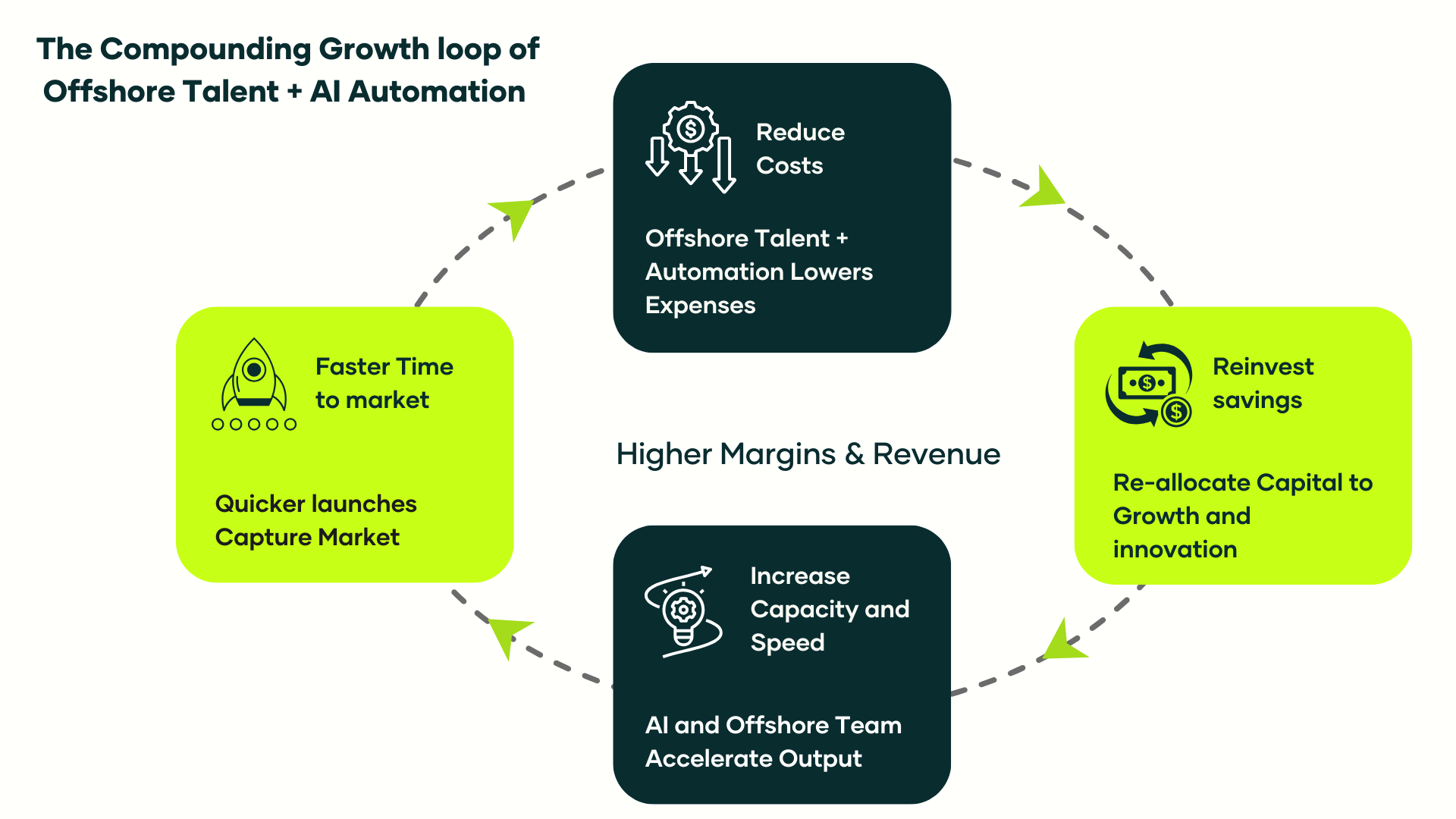
The Compounding Effect of Offshoring + AI Automation
Offshoring and AI automation don’t just cut costs or speed up delivery in the short term — they create a flywheel for growth. Every task automated frees your team for higher-value work. Every specialised offshore hire adds expertise that accelerates progress. Over time, these gains stack and reinforce each other: processes get sharper, delivery cycles get shorter, and innovations reach the market faster. The earlier you build this engine, the more exponential the payoff — and the harder it becomes for competitors to catch up. When you combine offshore talent with AI-driven process automation, you unlock a multiplier effect on productivity and profitability.
Cost Efficiency Gains – Offshoring can reduce staffing costs by 40–70% without compromising quality. AI automation typically delivers a 20–30% boost in process efficiency within the first 6–12 months.
Time-to-Market Acceleration – Offshore teams working in parallel time zones can cut delivery cycles by up to 50%, while AI-driven workflows shrink approval and execution timelines even further.
Innovation Through Capacity Release – A McKinsey study shows that AI frees up to 30% of an employee’s time for higher-value, strategic work. Combine that with offshore scaling, and you can double innovation output without doubling headcount.
Compounding Competitive Advantage – The earlier you implement, the stronger your edge. Gains from year one become the baseline for year two. By year three, the operational efficiency gap between adopters and late movers can widen to 2–3x in output per dollar spent.
This is not a one-off boost — it’s a growth engine. Every offshore hire and automated workflow feeds back into the system, lowering marginal costs, increasing delivery speed, and freeing up capital for reinvestment. Over time, this creates an advantage so entrenched that competitors are forced to play catch-up on your terms.
Where Remote Office Fits In
Most businesses know automation is powerful and offshore talent is cost-effective — but few have the operational expertise to integrate the two into a seamless, high-performance system. That’s where Remote Office comes in.
We:
Identify and automate high-friction processes before offshoring.
Source and onboard the right offshore talent matched to your workflows and culture.
Manage compliance, payroll, and day-to-day performance so your team can focus on results, not admin.
Powerful Insight: Businesses that combine automation and offshore talent effectively grow faster, run leaner, and outperform competitors still treating them as separate strategies.
4️⃣ The 80/20 Formula for Faster Scaling
The fastest-growing Australian companies in 2025 are applying a simple yet powerful principle: focus 80% of internal effort on high-value, growth-driving work — and outsource, automate, or AI-enable the other 20% that slows teams down.
Here’s how they do it:
1. Automate Repetitive, Rules-Based Work
A 2024 McKinsey study found that 60% of knowledge workers’ time is spent on repeatable processes that AI and RPA (Robotic Process Automation) can now handle at a fraction of the cost.
Case in point: Atlassian uses automation inside Jira to reduce software team admin work by 40%, freeing engineers to ship features faster and focus on innovation rather than ticket management.
Impact at scale: In companies with 100+ employees, even a 10% time saving equates to thousands of productive hours reclaimed each year.
Remote Office data shows businesses can save 40–60% on these roles while still accessing Tier 1 global talent with excellent English skills and aligned work culture.
Example: A Brisbane SaaS company hired an offshore product manager and DevOps engineer through Remote Office, accelerating release cycles by 50% without adding local payroll overhead.
3. Integrate AI + Human Workflows
The most successful teams don’t replace people with AI — they supercharge them.
Example: Canva integrates AI-driven image search, copy generation, and design recommendations into its creative workflow. This hybrid model reduces turnaround times from days to hours while maintaining brand quality.
Productivity boost: In creative, marketing, and technical teams, AI augmentation can make individuals 3–5x more productive.
The Compounding Effect: Offshoring + AI Automation
The payoff isn’t just in cost savings. Each improvement amplifies the others:
Automation cuts delays and eliminates repetitive work.
Offshore expertise extends your operational capacity without inflating costs.
AI augmentation speeds execution while improving quality.
When combined, these strategies create a self-reinforcing growth loop. Over 12 months, Australian businesses applying the 80/20 model have achieved:
2–4x faster project delivery
30–50% higher output
Significant improvement in customer satisfaction and team morale — without expanding local headcount.
When you combine offshoring with AI automation, you don’t just save costs — you create a compounding effect that accelerates competitiveness over time.
Cost Efficiency Multiplied: Offshoring can reduce labour costs by 40–70% depending on the role and market. AI tools can further automate 20–40% of repetitive tasks within those offshore roles. Together, this can translate to 60–85% reductions in operational expenditure for certain functions.
Time-to-Market Advantage: Offshore teams working across time zones enable near 24/7 workflows. AI-driven automation speeds execution further by cutting down analysis, QA, or admin cycles by up to 50%. Faster releases mean more market share captured, earlier.
Skill Leverage: With offshoring, you can tap into global specialists without geographical constraints. AI augments those specialists, allowing them to produce more in less time, often with higher accuracy.
Reinvestment Loop: The savings and productivity gains can be reinvested into R&D, marketing, or scaling—fueling compounding growth. Over a 3–5 year horizon, companies that reinvest these gains can outperform competitors by 2–3x in revenue growth.
Businesses that master both offshoring and AI automation aren’t just operating leaner—they’re building a self-reinforcing growth engine. Every cycle of savings and efficiency becomes capital for the next leap forward, creating a competitive gap that becomes almost impossible for slower adopters to close.
The takeaway: The earlier you implement this model, the greater your compounding advantage. Each cycle makes you faster, leaner, and more competitive, while late adopters struggle to catch up.
How Remote Office Fits In
This is exactly where Remote Office becomes your strategic growth partner. We integrate offshore teams seamlessly into your operations and align them with the right AI-powered workflows, so you can accelerate the loop without the trial-and-error risk. From talent sourcing to onboarding, cultural integration, and ongoing optimisation—we remove friction and set your scaling flywheel into motion from day one.
Final Word
Scaling in 2025 isn’t about hiring more people locally — it’s about finding the right people, in the right place, supported by the right tech.
The winners this year will be the ones who blend offshore talent with AI-driven automation, turning lean teams into high-output engines. Remote Office has helped Australian businesses in tech, finance, healthcare, and professional services:
Cut operational costs by up to 60% without compromising on quality
Accelerate delivery timelines by 30–50% through time-zone advantage and round-the-clock workflows
Increase project capacity by 2–3x without increasing headcount locally
Maintain >95% client satisfaction thanks to strong QA processes and skilled offshore hires
From SaaS startups that scaled development 3x faster, to accounting firms that reduced manual workloads by 70% using AI-assisted offshore teams — the compounding effect of these strategies is transforming entire industries.
The question isn’t whether offshore + AI will reshape your business model — it’s whether your competitors will get there first.
At Remote Office, we understand that the right team is the cornerstone of business growth. That's why we've transformed team building into an art, effortlessly guiding you through finding the perfect fit. Imagine shaping your ideal team from anywhere, with the expertise of a virtual HR partner at your fingertips. Our platform isn't just about team creation; it's a strategic ally in your journey to scale and succeed. Engage with our obligation-free tool and experience the power of tailored team-building, designed to address your unique business needs.
.png)


.png)
.png)

.png)
.png)
.png)
.png)
.png)
.png)
.png)