.png)
Offshore Staffing in Australia: What the 2026 Industry Outlook Really Means for Your Hiring Plan

Brian Kelly

July 6, 2026


Every year, the Australian Industry Group (Ai Group) surveys senior business leaders across manufacturing, construction, professional services, transport, utilities, and technology. The 2026 Industry Outlook—its thirteenth annual edition—captures the views of 225 senior executives representing businesses that collectively employ over 58,000 people, generate more than $41 billion in annual revenue, and account for 42.6% of Australia's industry value-add.
The report’s central conclusion is straightforward: the dominant challenge facing Australian industry in 2026 is managing the rising cost of doing business during subdued economic conditions.
While this appears to be a macro-level economic issue, a closer analysis reveals it is increasingly becoming a workforce strategy problem in disguise.
Most commentary focuses heavily on headline inflation figures and interest rates. However, the more critical story sits directly inside the operating economics of Australian businesses.
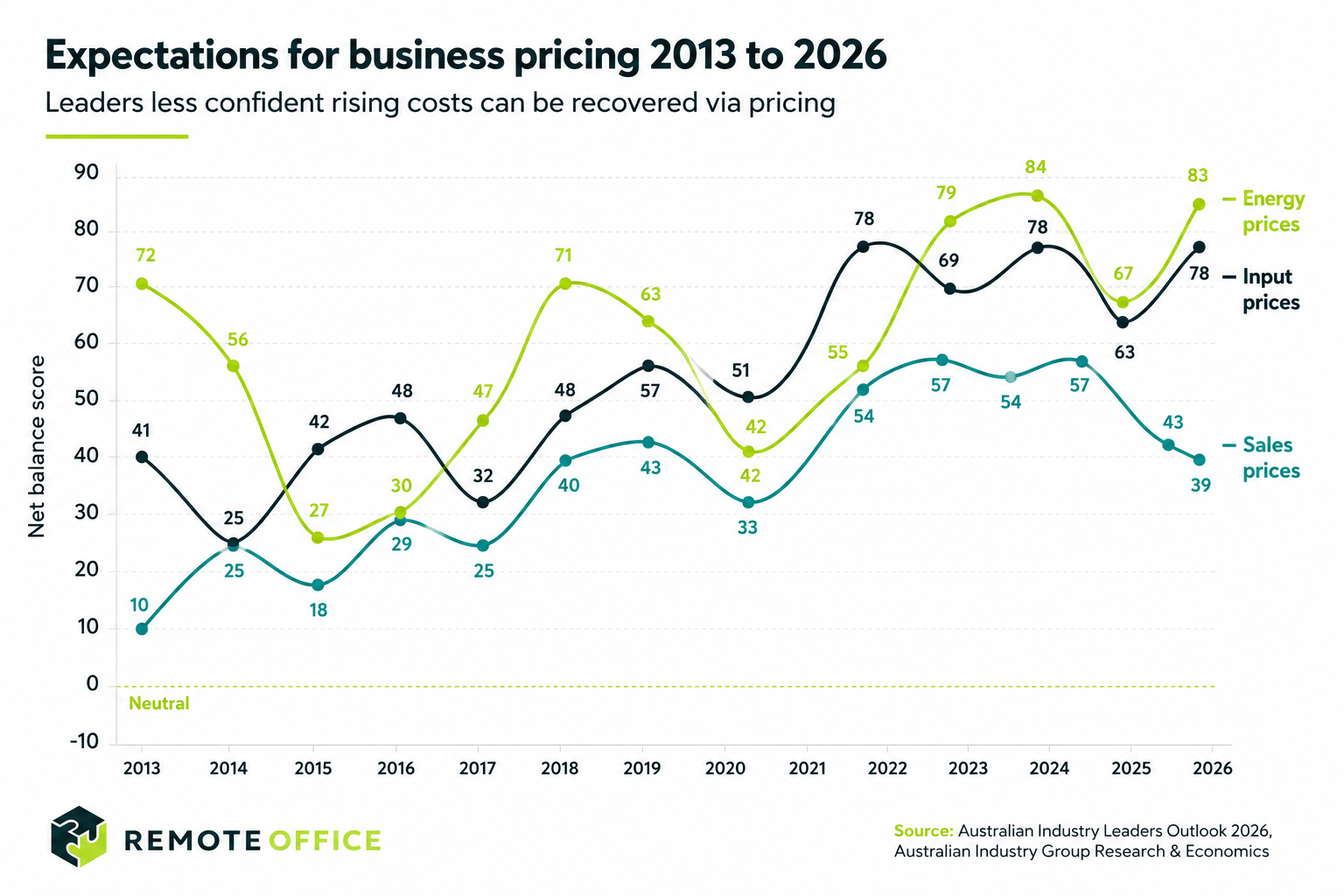
In practical terms, businesses expect core operating costs to continue rising, but subdued market conditions prevent them from passing those price increases on to customers. This leaves nowhere for those costs to land except directly on the balance sheet.
Despite positive expectations for top-line revenue growth, profit margin expectations remain slightly negative (-2 net balance). Revenue may rise, but profitability will be continuously absorbed by higher operating costs—creating a scenario where businesses are effectively running harder just to stand still.
The report demonstrates that taxation and regulatory compliance have evolved from administrative burdens into direct workforce planning barriers.
Among surveyed business leaders:
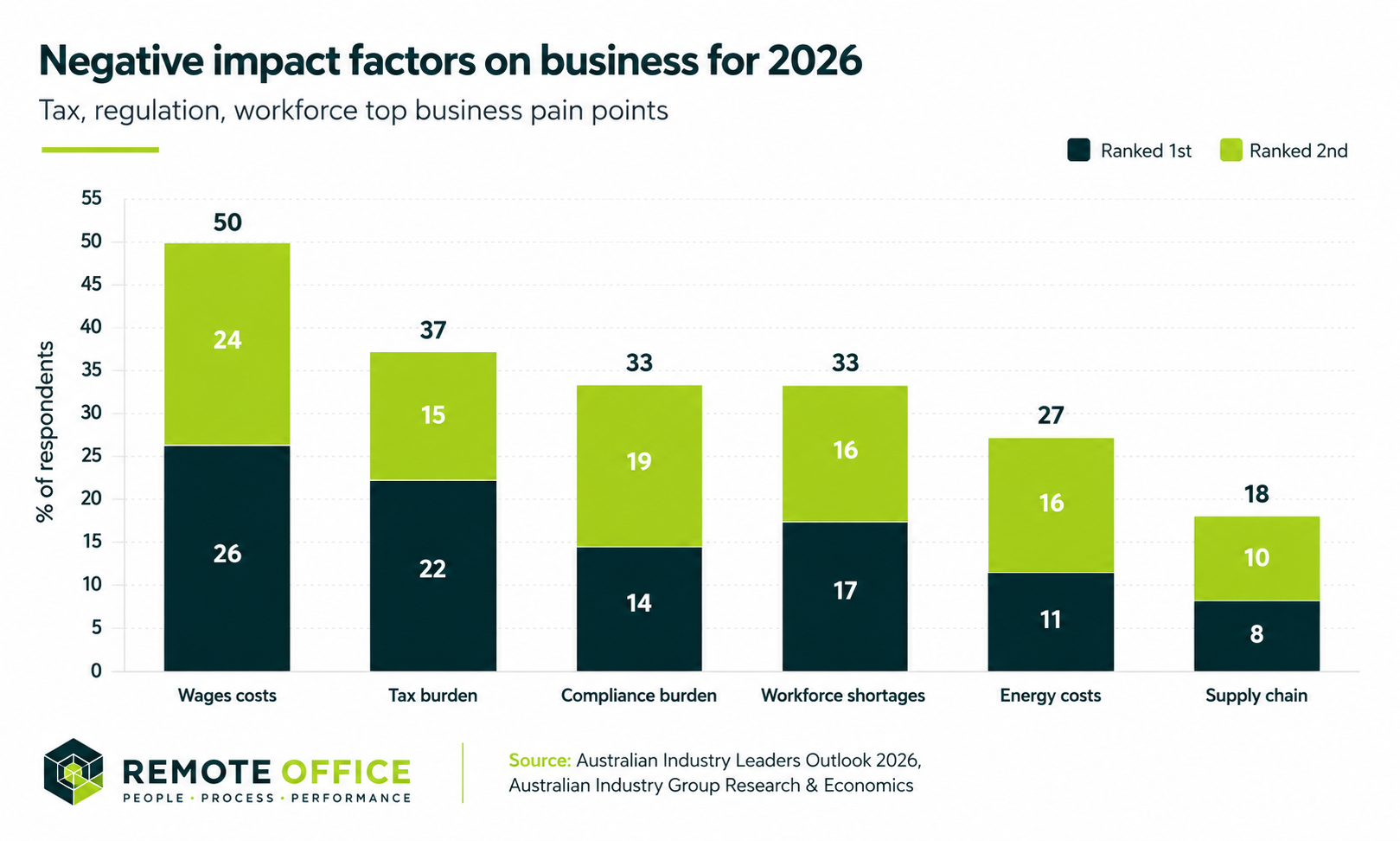
This reflects the reality that payroll tax is only one layer of an expanding local employment cost stack. Adding domestic headcount carries significant indirect costs and compliance obligations, including:
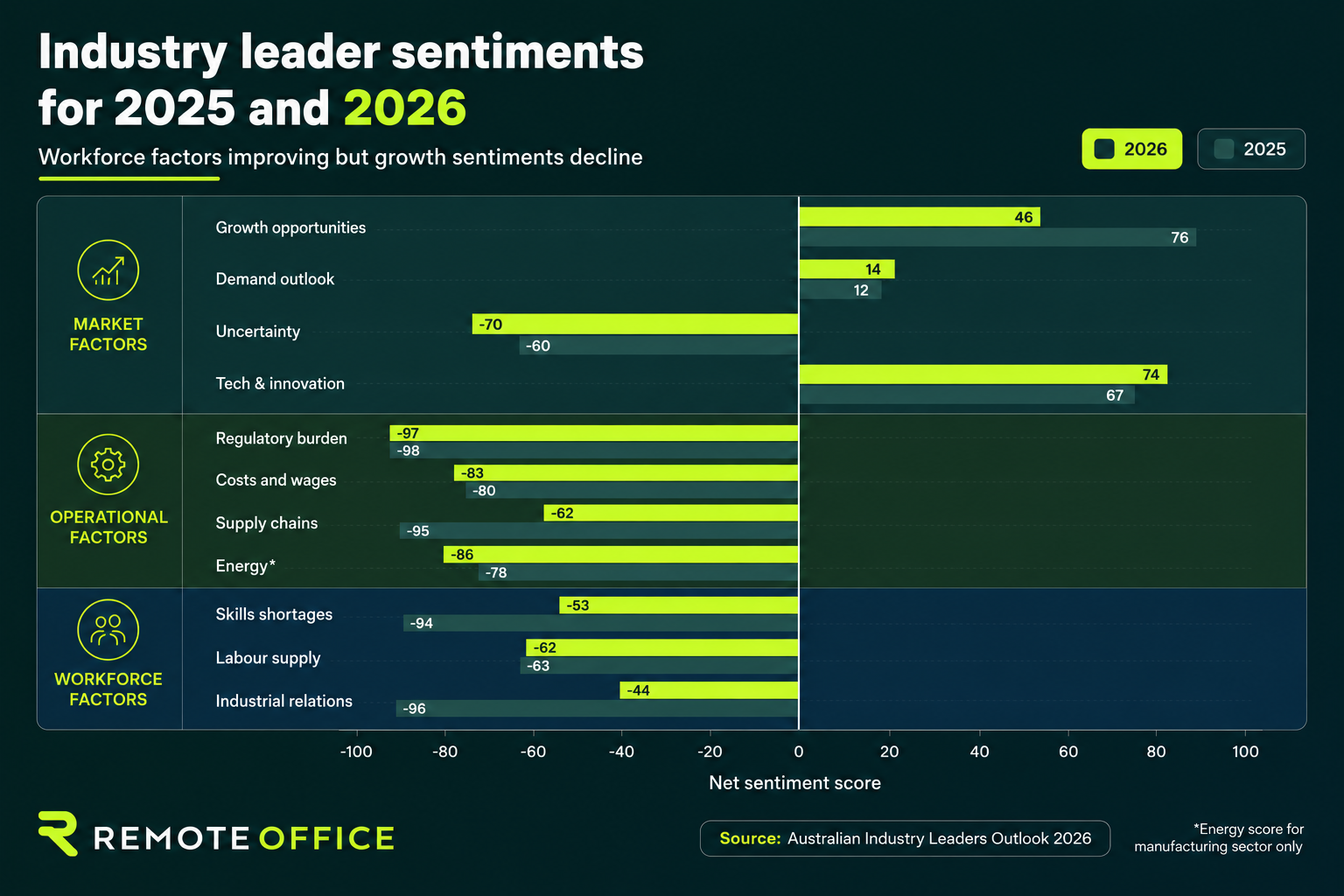
Furthermore, the survey recorded a net sentiment score of -97 for regulatory and compliance burden, making it the most negatively rated business factor measured in the entire report. For many Australian organizations, the primary challenge is no longer just sourcing talent—it is managing the growing cost and structural friction attached to employing that talent locally.
Headline numbers suggest labor constraints are easing across the board, with businesses reporting workforce shortages declining from 75% in 2024 to 67% in 2025. However, venturing one layer deeper reveals a stark split by skill level.
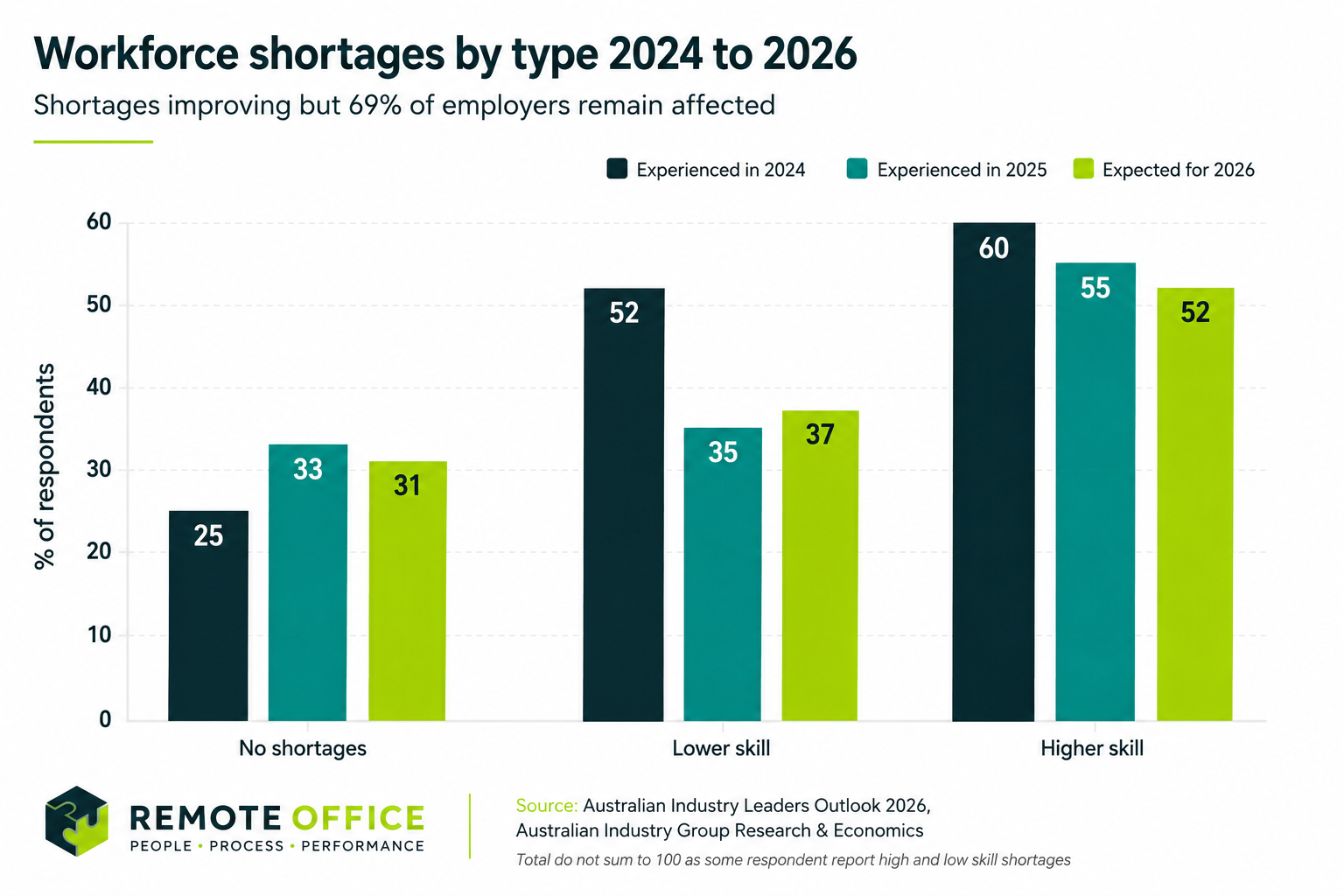
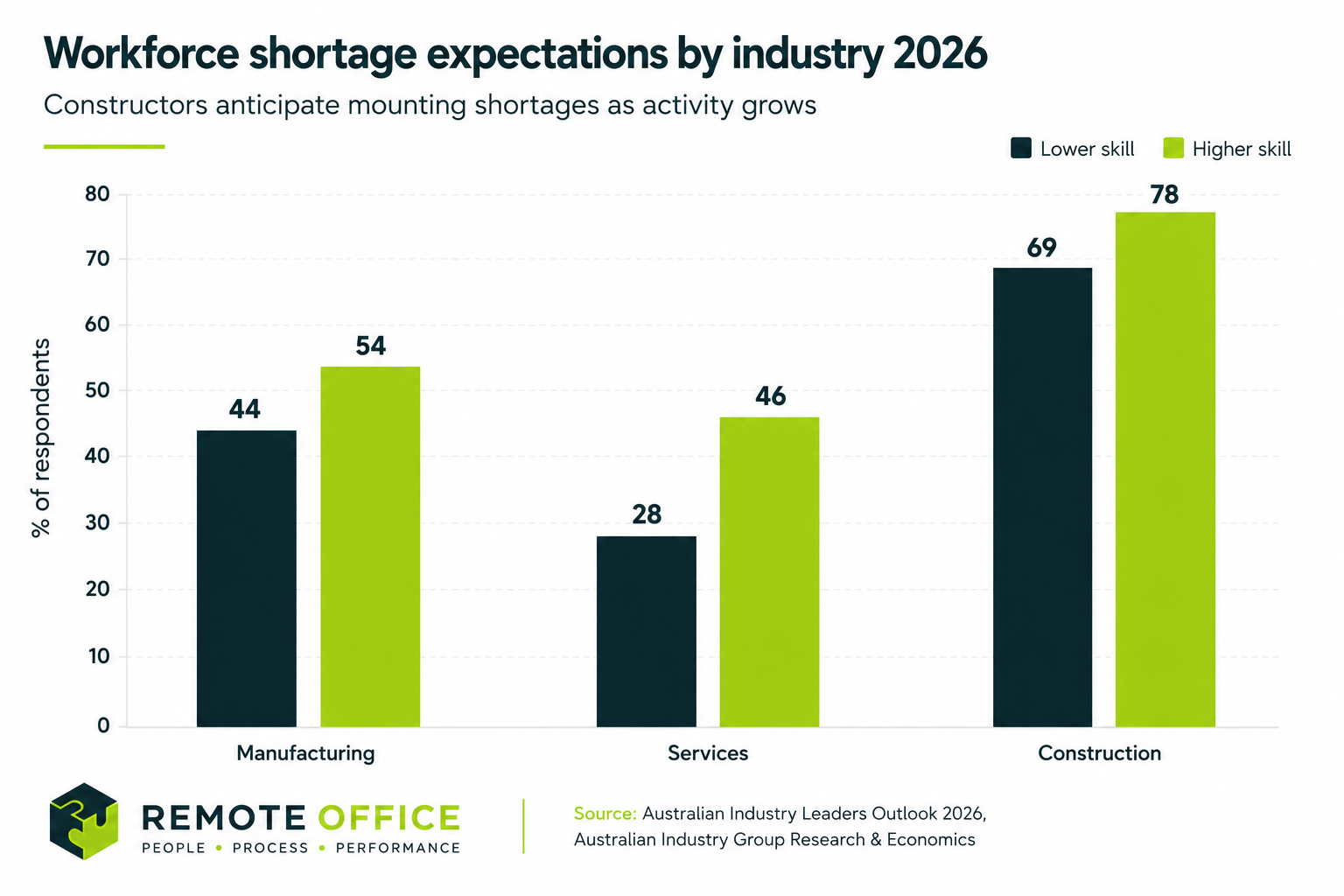
Construction illustrates the most acute version of this trend, with expected shortages affecting 69% of lower-skilled roles and 78% of higher-skilled positions. Jobs and Skills Australia currently lists every major construction trade in national shortage. Across the broader economy, 51% of all persistent national shortages are concentrated in Technicians and Trades Workers, underscoring that talent bottlenecks are heavily concentrated in technical and specialized roles rather than entry-level functions.
Technology is the only major investment category gaining momentum in the 2026 outlook. Almost half of Australian businesses (49%) intend to increase technology spending, producing a strong net investment balance of +34. Conversely, non-tech investment categories—including staff training, traditional capital expenditure, and research & development—are either flat or contracting.
Crucially, researchers note that this tech uplift is not primarily driven by growth ambitions or new product development (R&D ranked lowest at 11%). Instead, it represents "survival spending."
Business development (59%) and process improvement (50%) rank as the top two functional priorities for investment in 2026. Organizations are deploying automation, software, and AI tools as defensive measures: automating repetitive workflows, improving operational efficiency, and attempting to protect eroding profit margins against relentless domestic cost pressures.
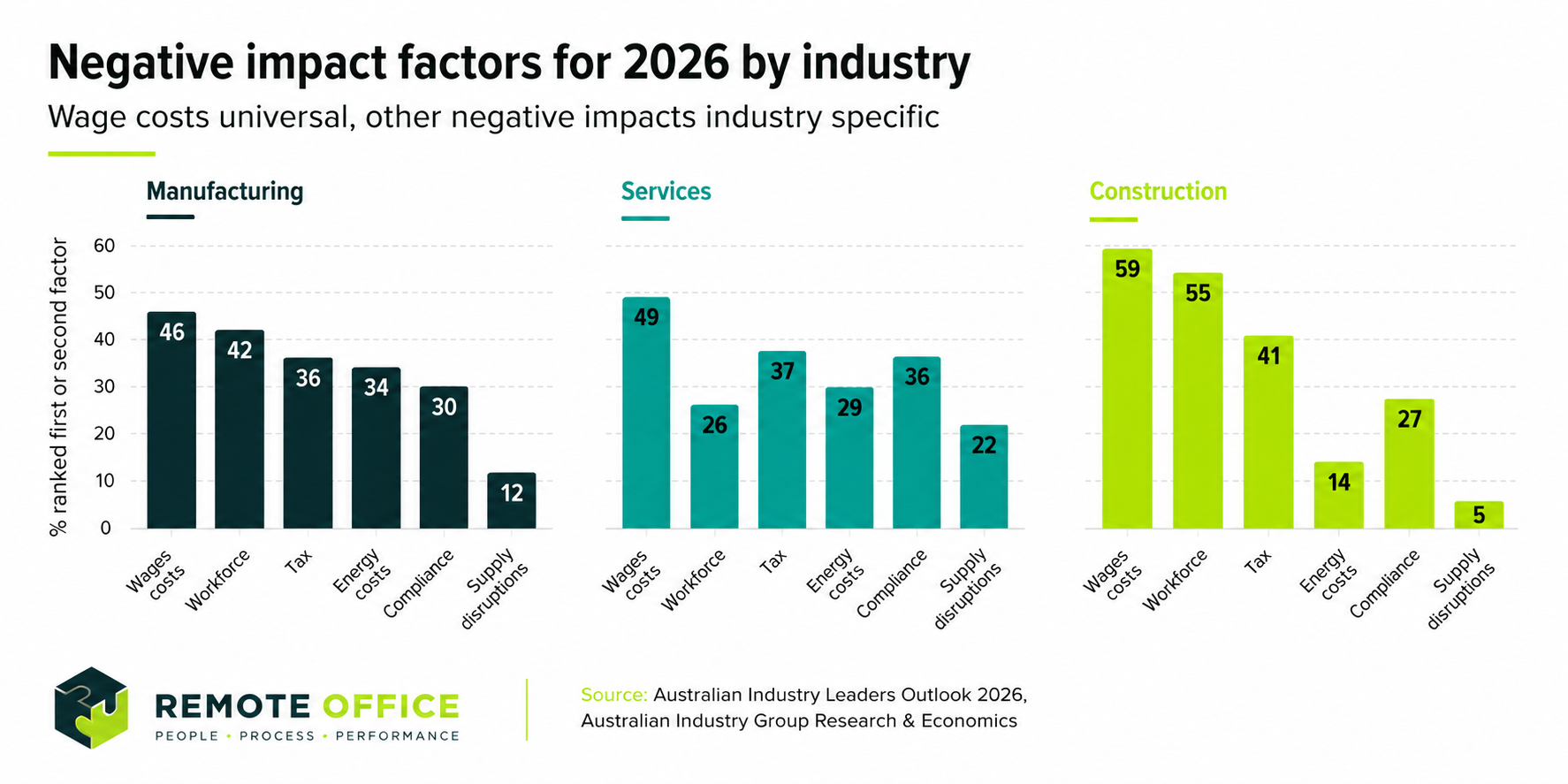
The economic headwinds facing Australian industry are not felt uniformly. Operating pressures vary significantly across sectors, dictating distinct operational challenges and strategic workforce requirements.
Service sector organizations report the heaviest compliance burden of any group—aligning with the survey's recorded net sentiment score of -97 for regulatory friction, the lowest reading in the report. Conversely, manufacturers face disproportionate margin pressure from energy cost spikes, given their reliance on electricity and gas inputs.
Because these pressures manifest differently, there is no single offshore staffing template. A construction firm deploying global capacity to alleviate administrative bottlenecks on-site is solving a fundamentally different problem than a SaaS enterprise scaling engineering support—even if both utilize global talent to achieve their goals.
Beyond direct technology investments, executive teams are actively pursuing targeted operational strategies to defend profitability:
This shift toward international procurement highlights a broader strategic pivot. As executive teams increasingly look overseas to manage supply chain costs, applying the same strategic logic to workforce design represents a natural progression. Sourcing specialized capability globally is no longer a radical decision; it is a standard operational strategy.
A crucial question arises: Does a global talent model remain compelling if broader economic conditions improve?
The survey data suggests it does. Even under improved revenue and demand projections, gross profit margin expectations remain net negative. A cyclical rise in demand does not resolve a structural cost problem; it simply places higher top-line revenue over an expensive operating structure.
Global workforce integration addresses the underlying cost structure directly—making it a vital strategy for long-term margin resilience across all market conditions, rather than a temporary fix for economic downturns.
Connecting the macroeconomic data from the 2026 Ai Group Industry Outlook reveals an unambiguous conclusion: domestic hiring in Australia now carries a compounding structural overhead.
Adding local headcount involves far more than gross salary. It includes statutory superannuation contributions, state payroll tax liabilities (identified by 74% of leaders as a primary influence on employment decisions), workers' compensation levies, and mandatory compliance frameworks—a environment reflected in the survey’s record net sentiment score of -97 for regulatory burden. Furthermore, local recruitment requires competing in a market where higher-skilled talent shortages persist at 55% overall (and reach 78% in sectors like construction).
These structural pressures are not temporary headwinds. With input cost expectations reaching a 13-year high and a record 39-percentage-point gap between rising business costs and selling price expectations, cost pressures can no longer be passed on to clients or absorbed domestically.
A properly structured offshore workforce model does not dilute operational governance—it reinforces it.
A dedicated offshore professional working aligned Australian business hours, embedded directly within your enterprise software and reporting hierarchies, differs fundamentally from transactional gig platforms or third-party call centers:
The survey data confirms that workforce constraints and cost inflation are persistent features of the operating landscape. The executive priority is no longer evaluating whether to integrate global talent, but establishing an operational framework that maintains quality, security, and governance.
Remote Office builds dedicated offshore teams across software engineering, IT infrastructure support, customer operations, and back-office financial services. Every team member functions as a direct extension of your onshore business—operating during Australian business hours and reporting through your existing management structure.
This approach addresses the core limitations of traditional resourcing models:
Remote Office establishes offshore capability through structural discipline: mandatory process mapping prior to recruitment, defined KPI baselines from day one, clear escalation protocols, and built-in retention frameworks.
Organizations deploying this integrated structure achieve three clear operational advantages:
The 2026 Industry Outlook outlines a business environment where structural cost inflation, regulatory overhead, and specialist talent scarcity form the baseline operating condition. Treating these conditions as a temporary phase to be managed via hiring freezes or incremental budget cuts guarantees persistent margin erosion.
The organizations maintaining competitive advantage are those transitioning to a resilient hybrid workforce model:
Whether scaling engineering output for a SaaS platform, maintaining 24/7 coverage for an MSP service desk, or streamlining back-office administration for a growing property portfolio, the solution is rarely adding domestic headcount at fully loaded local costs.
If cost pressures and talent bottlenecks are impacting your operating margins, Remote Office provides the infrastructure, recruitment rigor, and governance required to scale successfully.
Schedule a Workforce Planning Consultation with Remote Office to map out your global talent strategy for 2026 and build long-term margin resilience into your operational model.
Explore how Remote Office helps you build and scale high-performing offshore teams aligned to your business and delivery needs.

.png)
.png)
.png)
.png)
.png)
.png)
.png)